
Aanchal Parmar
Product Marketing Manager, Flexprice

Orb was acquired by Adyen. Metronome was acquired by Stripe. Two of the biggest names in usage-based enterprise billing are now owned by incumbents who were built for a completely different era of software pricing.
I've been building billing infrastructure for AI-native and SaaS companies long enough to know what this gap means in practice.
If you're evaluating enterprise billing software right now, this guide breaks down how the market looks today, what each category of tool actually handles, and where Flexprice fits in.
What is enterprise billing software?
Enterprise billing software automates invoicing, complex subscriptions, and revenue recognition at scale.
It's built for companies that have outgrown basic billing tools and need infrastructure that can handle dynamic pricing models, global tax compliance, and integrations with existing ERP and CRM systems without breaking down every time pricing changes.
The difference between enterprise billing software and a basic billing tool comes down to one thing and we call it complexity.
A product with flat-rate pricing can comfortably function with Stripe and few systems built on top of it. And this setup works for a handful of PLG customers and enterprise contracts. But the moment you say that you’re scaling with a lot of customers and have a good influx of enterprise customers every month, this setup is just not enough.
And when it falls apart it falls apart in the worst possible places, wrong invoices, unbilled usage, finance team losing their mind. That's what enterprise billing software is actually solving for.
Top 7 enterprise billing software for AI and saas in 2026
Flexprice
Orb
Metronome
Chargebee
Stripe billing
Maxio
Zuora
Basis | Flexprice | Orb | Metronome | Chargebee | Stripe Billing | Maxio | Zuora |
Core positioning | Open-source,usage-first enterprise billing built for AI and SaaS monetization | Engineering-first real-time usage billing for API-driven SaaS products | Usage-based enterprise billing is tightly integrated within the Stripe ecosystem | Subscription-first SaaS billing with revenue operations and reporting capabilities | Programmable subscription billing is deeply embedded in Stripe Payments | Finance-led subscription billing with strong revenue recognition controls | Legacy enterprise monetization platform focused on subscription governance and compliance |
Best suited for | AI-native SaaS needing hybrid pricing, credits, and fast iteration | Developer-led SaaS monetizing APIs, compute, or infrastructure usage | Stripe-native companies monetizing infrastructure and postpaid usage models | Traditional SaaS businesses operating with predictable recurring subscription revenue | SaaS teams are fully committed to Stripe for payments and billing | B2B SaaS organizations prioritizing financial reporting and compliance workflows | Large enterprises prioritizing compliance, governance, and global operations |
Billing system of record | Usage events and billing configuration serve as the primary revenue source | Usage ingestion pipeline drives billing calculations and invoice generation | Stripe subscription and metering objects act as a system of record | Subscription catalog and recurring contracts define revenue logic | Stripe objects, including subscriptions, meters, and invoices, define billing logic | Subscription contracts and financial records define billing workflows | Subscription agreements and finance rules control billing operations |
Real-time usage metering | Native high-throughput metering supporting granular AI usage tracking | Real-time event ingestion optimized for developer-centric architectures | Real-time metering is available but limited to Stripe ecosystem boundaries | Usage tracking is available, but secondary to subscription workflows | Basic metering suitable for simple consumption-based pricing models | Limited native metering capabilities compared to usage-native platforms | Not designed primarily for real-time consumption-heavy workloads |
Hybrid pricing support | Native support for subscriptions, credits, usage, and overages in one model | Supports hybrid models via APIs and configuration layers | Hybrid billing is possible, but often requires Stripe-based orchestration | Hybrid supported through add-ons layered over subscriptions | Subscription plus usage supported; credits require custom modeling | Supports tiered and hybrid models within a subscription framework | Supports subscription and usage, but rigid contract structures |
Credit wallets / prepaid usage | First-class wallet abstraction with balances, expiration, and burn rules | Limited wallet-style support; mostly subscription-based usage charges | Prepaid constructs are possible through enterprise contract configurations | Credits modeled via adjustments, not native wallet ledger | No native wallet abstraction; handled through invoice logic | No dedicated wallet abstraction for prepaid consumption billing | No first-class wallet or prepaid credit abstraction |
Entitlements & feature gating | Billing-native entitlements control access, quotas, and feature limits | Feature enforcement is typically handled in application logic | Entitlements managed externally within product infrastructure | Strong plan-based entitlements tied to subscription tiers | Entitlements exist, but enforcement resides in application code | Feature gating is generally handled outside the billing layer | Entitlements and gating are typically managed through external systems |
Enterprise contracts support | Built-in support for commitments, ramps, and true-up billing structures | Enterprise contracts are possible, but require configuration effort | Supports minimum commitments and complex postpaid usage agreements | Enterprise contracts supported through catalog and pricing controls | Contract modeling achievable but operationally complex at scale | Designed for structured enterprise subscription agreements | Strong enterprise contract engine with compliance oversight |
Parent–child billing | Native hierarchical accounts with consolidated billing and shared usage | Partial support requiring custom modeling for shared usage | Parent-child structures are supported within the Stripe-based hierarchy | Account hierarchies are supported mainly for invoicing purposes | No native consolidated parent-child billing support | Supports hierarchies within financial reporting workflows | Robust multi-entity and global consolidated billing support |
Pricing changes without engineering | Finance and product teams configure pricing without developer dependency | Most pricing adjustments require engineering involvement | Pricing logic changes require engineering configuration in Stripe | Business teams can manage subscriptions; complex pricing needs engineering | Developers must update billing objects via code | Some pricing is configurable; advanced scenarios require operational workarounds | Pricing changes often require specialized administrators or consultants |
Auditability & traceability | Event-level traceability linking usage directly to invoice line items | Usage traceable to invoices via event logs | Stripe invoices link to metered usage, but have limited context | Invoice totals clear; deep event traceability requires internal telemetry | Invoice line items visible; raw usage context external | Invoice reporting is strong; usage-level traceability is limited | Audit-ready invoicing aligned with compliance reporting standards |
Revenue recognition | Supports enterprise-grade revenue reporting and compliance workflows | Revenue recognition is typically handled via external finance systems | Revenue recognition managed within Stripe’s broader ecosystem | Built-in revenue recognition aligned with SaaS accounting standards | Stripe ecosystem supports revenue tooling and tax compliance | Strong GAAP and ASC 606-compliant revenue recognition | Comprehensive revenue recognition and IFRS/ASC compliance support |
Gateway flexibility | Billing logic decoupled from processors; integrates multiple gateways | Gateway-agnostic billing with external payment integrations | Fully dependent on Stripe Payments infrastructure | Supports multiple payment gateways across regions | Deeply integrated and restricted to Stripe Payments | Multi-gateway support across major processors | Multi-gateway support for global enterprise operations |
Implementation speed | Production-ready deployment is achievable within hours to weeks | Implementation typically requires an engineering-led setup over weeks | Sales-led onboarding with engineering configuration timeline | Moderate implementation effort depending on contract complexity | Fast setup if already using Stripe infrastructure | Implementation can require structured onboarding and data migration | Long enterprise implementations often span several months |
Vendor lock-in risk | Open-source foundation minimizes long-term vendor dependency risk | Low lock-in risk due to flexible integration architecture | High dependency on the Stripe ecosystem for billing and payments | Moderate dependency tied to subscription-centric workflows | High dependency within the Stripe ecosystem | Moderate vendor reliance due to proprietary architecture | High switching cost due to enterprise-grade customization |
Primary user persona | Product, finance, and RevOps teams collaborating on monetization | Engineering teams owning pricing and usage infrastructure | Engineering-driven organizations operating within Stripe | RevOps and finance teams managing recurring revenue | Developer-first teams are comfortable building billing logic | Finance-led organizations requiring structured financial governance | Enterprise finance and operations leaders overseeing compliance |
Pricing transparency | Transparent, usage-aligned pricing without percentage revenue fees | Pricing disclosed via sales engagement | Pricing undisclosed; structured around usage and Stripe fees | Tiered pricing based on revenue and feature access | Percentage-based billing plus Stripe processing fees | Tiered subscription pricing with enterprise customization | Enterprise pricing model negotiated through sales contracts |
1. Flexprice
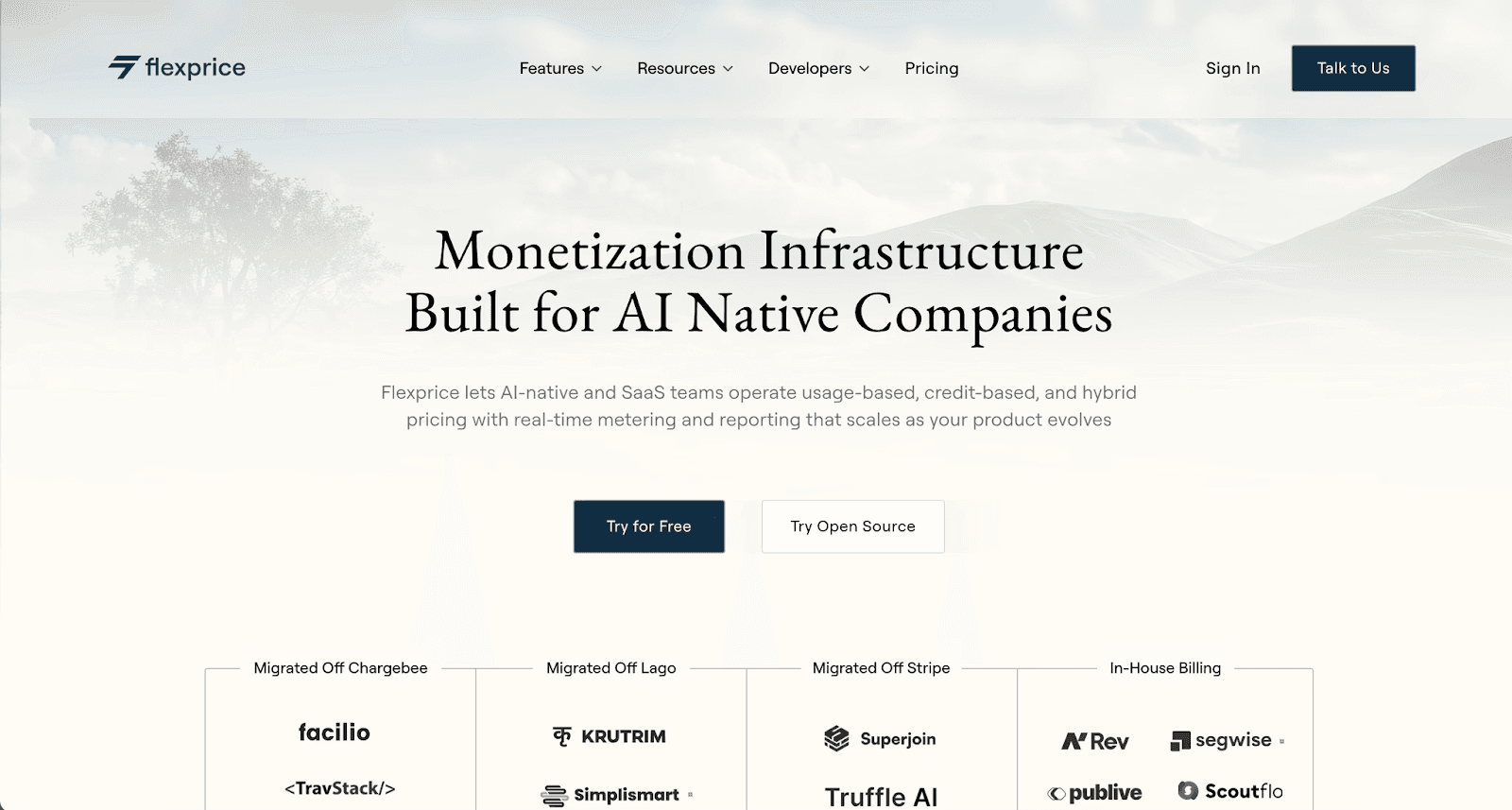
Okay full disclosure, Flexprice is my product so feel free to scrutinize it however you want. But if something like Flexprice had existed four years ago trust me my work would have been so so much easier. And everything we've built comes from that experience, not just talk.
Flexprice is an open-source enterprise billing platform for SaaS and AI companies that charge based on usage, credits, or hybrid pricing. It ingests usage in real time, converts it into billable revenue through automated metering, and lets finance and product teams define pricing rules from the dashboard without pulling in engineering every time something changes.
What makes it worth paying attention to is how it handles the stuff that breaks other systems. Multi-year ramped contracts, credit pooling across parent-child account hierarchies, granular usage filtering within a single event stream. These aren't demo features. They're what enterprise billing actually looks like in production.
Here's what it covers:
Usage-based pricing: Combine usage pricing with hybrid plans and committed volumes in one billing flow. No custom aggregation logic needed in your backend.
Credit workflows: Prepaid balances, recurring grants, rollover rules, automated top-ups, all tracked through a ledger-backed system. Finance gets auditability. Customers get spend visibility.
Ramped contracts: Phased pricing timelines that update automatically. Model a pilot-to-scale contract directly in billing without touching backend logic.
Quotes and renewals: Sales generates enterprise quotes with approvals built in. Everything syncs with billing automatically. One source of truth across contracts and invoicing.
Committed usage and credit pooling: Set organization-level commitments, share credits across teams, track pooled consumption in real time. Built for enterprises where budget is centralized but usage is distributed.
Parent-child accounts: Roll up usage from child accounts to a parent. Centralize invoicing while keeping team-level visibility.
Granular usage filtering: Price within a single event stream using metadata like model type or region. One stream, multiple pricing dimensions. This one saves a lot of headaches.
Feature entitlements: Feature gating integrated directly with billing. Define access by plan tier, enforce limits automatically, reset quotas on billing cycles.
Compliance: SOC II compliant.
"Flexprice made it super easy to create and sell custom plans based on usage in minutes and eliminated our reliance on in-house hacks." Aradhya Shandilya, Head of Product Management, Nurturev.
Pricing
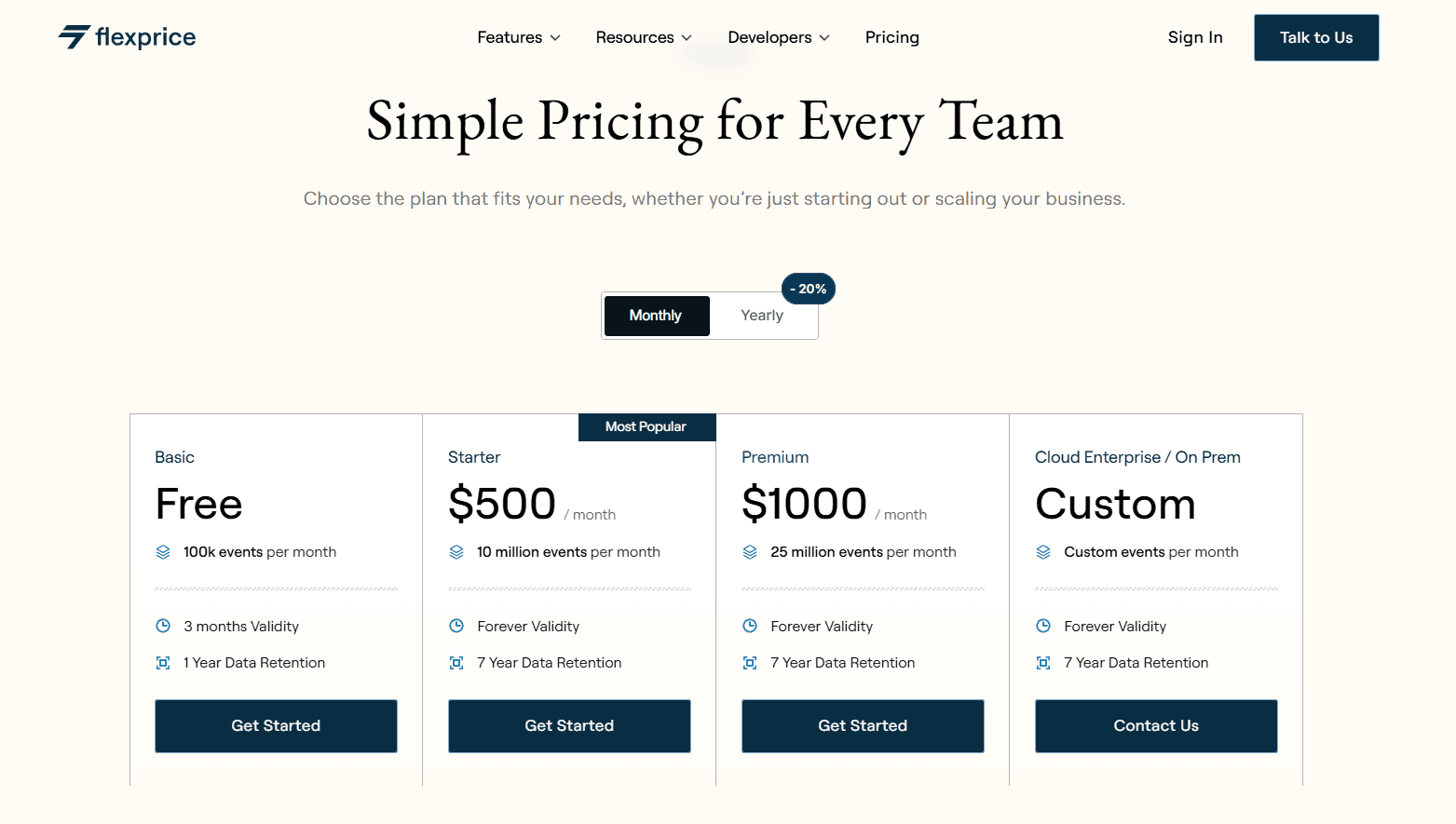
Flexprice offers 4 different pricing options apart from open source, which are:
Basic- free- 100k events per month
Build- $500 / month with 1 million events per month
Scale- $1000 / month with 5 million events per month
Mission critical- custom
Best suited for
AI platforms billing tokens, inference, or compute at scale
SaaS products using hybrid subscription + usage pricing
Teams needing entitlement control without hardcoded logic
Companies avoiding payment gateway lock-in
Products with high-variance or unpredictable consumption
2. Orb
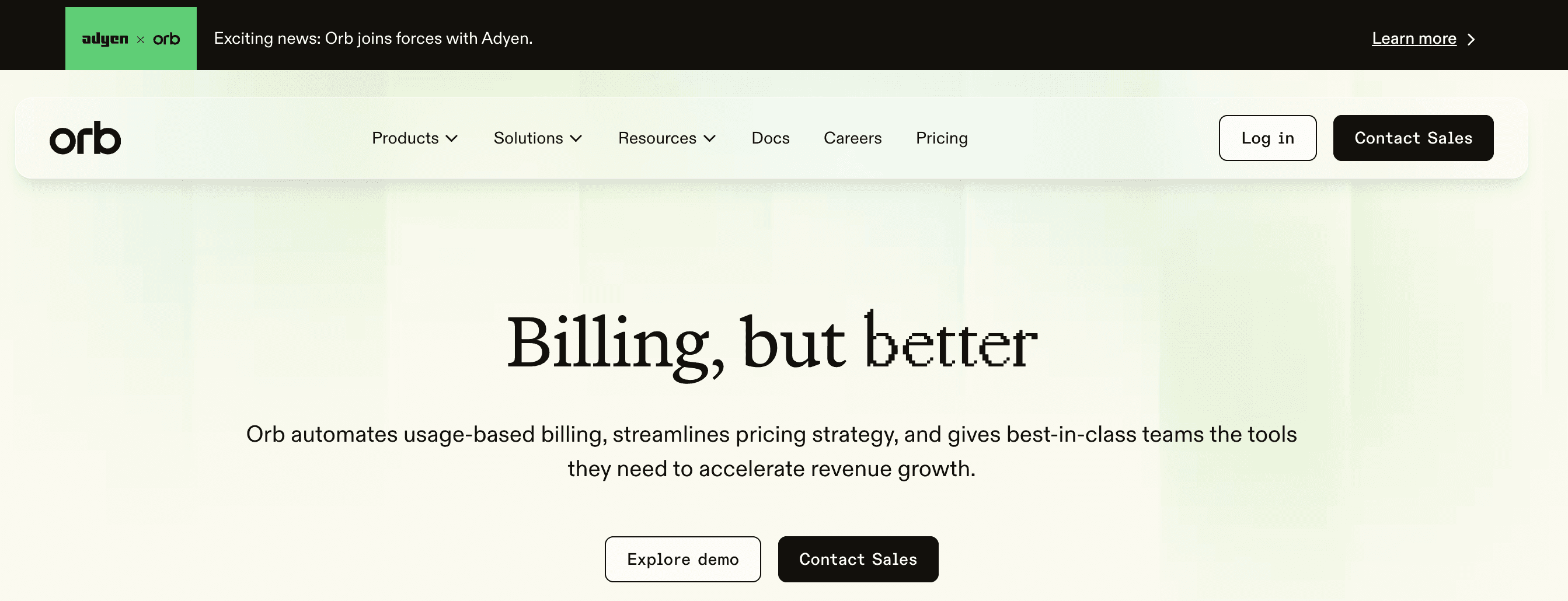
Orb is a platform built around event-driven billing and metered pricing. It ingests large volumes of usage events and translates them into billable revenue, acting as a billing layer between your product and your payment system.
It's engineering-first, which is both its strength and its personality. If your team is developer-heavy and comfortable with APIs and SQL, Orb will feel like home.
If you're looking for something your finance or product team can operate without engineering involved, it gets a little less comfortable.
One thing worth knowing is that Orb got acquired by Adyen in 2026. If vendor independence matters to you, that's worth factoring into the decision. The product is still good. The roadmap is just no longer entirely Orb's to control.
Here's what it does:
Usage metering: Ingests product usage events in real time and converts them into billable metrics. You define pricing based on custom dimensions like API calls, compute, tokens, or storage.
Pricing flexibility: Supports subscriptions, usage-based pricing, tiered rates, and hybrid models combining base plans with consumption overages. Pricing rules are configured via APIs and dashboards.
Subscription management: Handles plan lifecycle changes including upgrades, downgrades, prorations, and renewals. Good for SaaS products transitioning from seat-based to usage-based revenue.
Usage-linked invoicing: Invoices are generated directly from metered usage with line items traceable back to underlying events. Finance teams can actually validate charges without a separate reconciliation exercise.
Data pipeline integrations: Connects with modern data stacks and warehouses so engineering teams can push usage data from existing analytics pipelines directly into billing.
Pricing
Orb uses a usage-based pricing model tied to metered revenue volume. Exact pricing is not publicly listed and requires speaking with sales.
Best suited for
Developer-first SaaS and API products monetizing directly from usage events
Engineering teams that prefer API/SQL-driven pricing over no-code tools
Companies handling large volumes of real-time consumption data (APIs, infra, AI)
Businesses transitioning from flat subscriptions to usage-led or hybrid billing
Teams that need highly traceable, usage-backed invoices for finance accuracy
3. Metronome
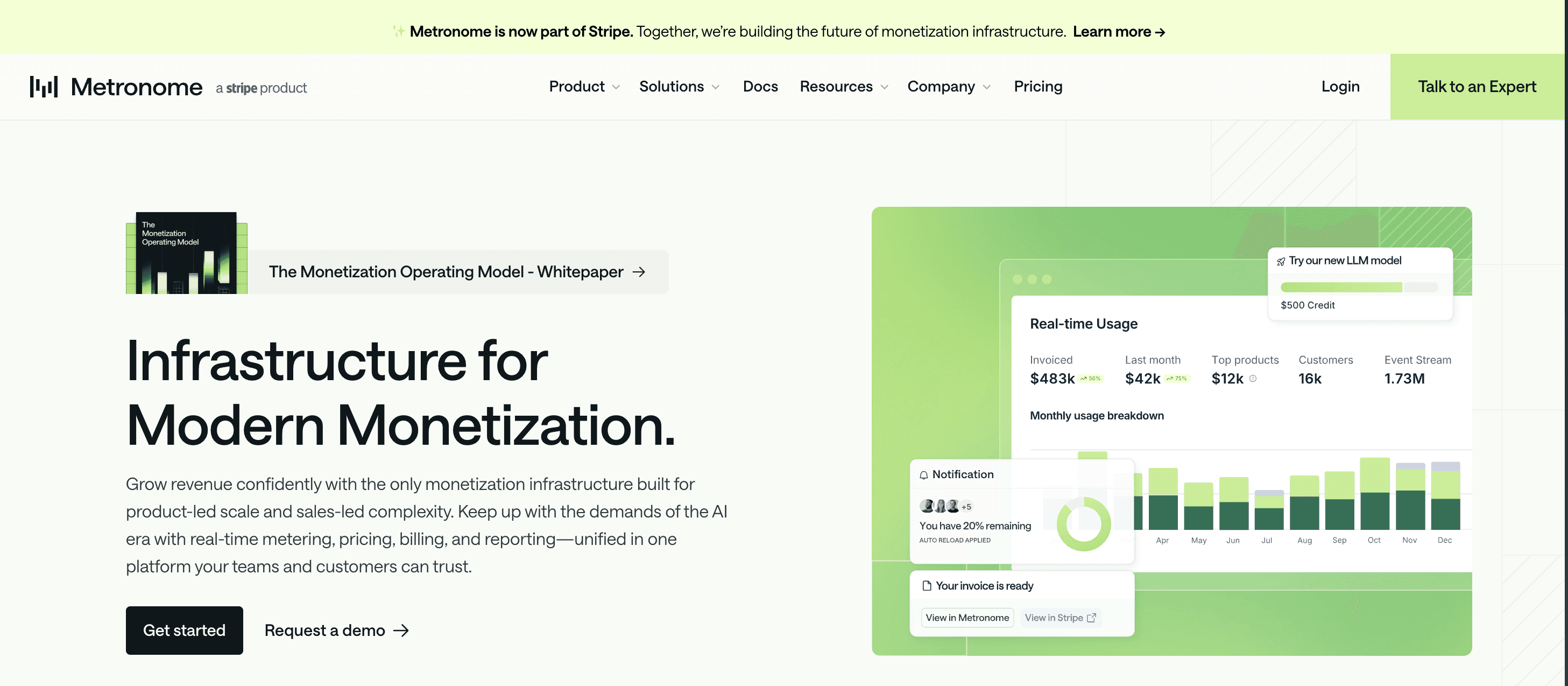
Metronome was built by former Dropbox engineers to solve a very specific problem: taking high-volume consumption data and turning it into enterprise revenue.
API calls, tokens, compute minutes, all of it converted into billable metrics with support for the kind of complex contracts enterprise sales teams actually close.
For a while it was one of the best options in this category. Then Stripe acquired it in December 2025.
I genuinely don't know how to feel about this. On one hand, Metronome's infrastructure is solid and the acquisition puts serious resources behind it.
On the other hand, if you chose Metronome because you wanted independence from your payment processor, that ship has sailed. You're in Stripe's ecosystem now whether you planned for that or not.
If you're already all-in on Stripe and running a consumption-heavy AI or infrastructure product, Metronome still makes sense. If you're not, the acquisition changes the calculus in ways worth thinking through carefully.
Here's what it does:
Event-based usage metering: Ingests raw usage events and aggregates them into billable metrics across dimensions like API volume, compute, or tokens. Built for postpaid billing on infrastructure-style products.
Enterprise account hierarchies: Supports parent-child account structures for organizations managing billing across multiple business units or customers.
Postpaid consumption billing: Built primarily for billing after usage occurs. Good fit for API platforms, cloud services, and AI infrastructure charging by volume.
Contract complexity management: Handles minimum commitments, prepaid credits, usage overages, and negotiated thresholds. The stuff that shows up in real enterprise deals.
Dimensional pricing: Pricing varies based on customer attributes like region, tier, or segment. Useful for differentiated enterprise contracts.
Pricing
Metronome does not publish pricing publicly. So to learn more, you will need to contact their sales team from their website.
Best suited for enterprise teams that
Already use Stripe as their primary payment processor
Monetize infrastructure, APIs, or AI workloads via postpaid usage
Have strong internal engineering resources to manage billing logic
Need support for large enterprise contracts with minimum commitments
4. Chargebee
Chargebee is the one most people have heard of. It's been around long enough that it shows up in almost every billing conversation, and for subscription-first SaaS companies it genuinely earns that reputation.
Recurring billing, invoicing, dunning, revenue reporting, CRM integrations, it handles all of it cleanly.
Where it gets complicated is usage-based billing. Chargebee has added metered billing over time but it feels like exactly that, something added on rather than built in.
If you're running a subscription business with light usage components on top, it works fine. If usage is your primary pricing model, you'll likely find yourself working around the platform more than working with it.
Here's what it covers:
Subscription lifecycle management: Trials, upgrades, downgrades, prorations, renewals, cancellations. This is where Chargebee is genuinely strong. If your product runs on seat-based or plan-based pricing, it handles the full lifecycle well.
Hybrid billing: Supports metered add-ons layered on top of subscriptions. Usage billing exists but works as an extension of subscription plans rather than a first-class capability. Worth keeping in mind if consumption is central to how you charge.
Enterprise invoicing and revenue operations: Automated invoicing, tax handling, dunning, and integrations for quote-to-cash workflows. Finance and RevOps teams tend to like it because it fits how they already work.
Customer account management: Customer records, billing profiles, payment methods, all managed in one place with tooling aimed at finance and RevOps rather than engineering.
Integrations: Native connections to Stripe, Salesforce, NetSuite. If your RevOps stack already includes these, Chargebee slots in without much friction.
Pricing
Chargebee pricing is tiered based on revenue and feature access, with enterprise plans negotiated through sales. One thing I'd flag honestly is the revenue-based pricing model means your Chargebee costs grow as your revenue grows. At lower volumes that's fine. At enterprise scale it adds up in ways that aren't always obvious when you sign the contract.
Best suited for enterprise teams that
Operate primarily on subscription-based SaaS models
Need mature invoicing and RevOps workflows
Rely heavily on CRM + accounting integrations
Run sales-led SaaS with predictable recurring revenue
5. Stripe billing
If you're already on Stripe for payments, Stripe Billing is the path of least resistance. No new vendor, no new contract, everything lives in one place. I get why teams default to it and honestly for a lot of early-stage SaaS companies it's the right call.
The honest version though is that Stripe Billing was built for subscription billing first. Usage-based pricing exists but it works best for straightforward scenarios.
The moment you're dealing with multi-metric metering, complex hybrid plans, or enterprise contracts with committed spend and overages, you'll start running into walls that require custom engineering to get around.
And now that Stripe has acquired Metronome, it's interesting to see where the usage billing capabilities go from here. I genuinely don't know yet.
The thing about Stripe Billing is it's genuinely excellent at what it was designed for. The frustration shows up when companies try to stretch it beyond that.
If you're early stage, subscription-first, and comfortable with code-heavy implementation, it's a solid starting point. If you're running usage-based or hybrid pricing at any real scale, you'll likely outgrow it faster than you expect.
Here's what it covers:
Subscription and plan lifecycle management: Recurring plans, upgrades, downgrades, prorations, and renewals all handled well. This is the core use case and it shows.
Basic usage billing: Supports usage-based charges on top of subscriptions via Stripe Meters. Works well for simple consumption scenarios. Multi-metric metering or complex pricing logic typically needs additional engineering on top.
Invoicing and collections: Native invoicing tied directly to Stripe Payments with automatic tax calculation, payment retries, and dunning. Clean and reliable for standard billing workflows.
CRM and financial integrations: Broad integrations across Stripe's ecosystem. For complex revenue operations you'll likely need additional tooling alongside it.
Pricing
Stripe Billing pricing is not disclosed publicly; you can check their website.
Best Suited For
Enterprise teams that already use Stripe as their sole payments platform.
Organizations with subscription-centric billing and minimal usage complexity.
Companies are comfortable with engineering-led custom usage logic.
Teams are prioritizing Stripe’s payment ecosystem over billing autonomy.
6. Maxio
Maxio came together from the merger of Chargify and SaaSOptics, which is actually a pretty telling origin story. Chargify was a billing tool. SaaSOptics was a financial reporting tool. Put them together and you get a platform that sits at the intersection of billing operations and finance, which is exactly what Maxio is.
If your CFO is the one pushing for a billing platform upgrade, Maxio is probably on their shortlist. It's built for finance teams as much as it's built for engineering, and that shows in how the product works.
Where Maxio gets complicated is usage-based billing. It supports it, but usage billing was layered on over time rather than built as a foundation. For subscription-heavy businesses with usage as a secondary component it works well. For companies where consumption is the primary pricing model, it's worth stress-testing before you commit.
Here's what it covers:
Financially aware subscription billing: Automates subscription lifecycles, invoicing, and billing operations with support for flat, tiered, usage-based, and hybrid pricing configurations. The billing and financial reporting stay connected rather than living in separate systems.
Revenue recognition and compliance: Built-in GAAP, ASC 606, and IFRS 15 compliance. Revenue reporting is audit-ready out of the box, which matters a lot when you're closing enterprise deals or preparing for a fundraise.
Advanced financial analytics: Real-time dashboards for ARR, MRR, churn, cohort trends, and revenue waterfalls. This is genuinely one of Maxio's stronger suits. Finance teams get the kind of drill-down reporting that usually requires a separate BI tool.
Collections and multi-gateway support: Automated collections, payment retries, and dunning across multiple payment gateways with collection events tied back to customer accounts for finance visibility.
Integrations: Salesforce, QuickBooks, Avalara for tax automation. Solid coverage for standard enterprise finance stacks.
Pricing
Maxio offers tiered plans that reward growth, starting around $599/month for standard billing and rising to custom enterprise pricing for high volume and advanced revenue operations.
Best suited for enterprise teams that:
Operate complex subscription billing and revenue recognition workflows
Require audit-ready financial reporting and compliance
Need deep integration with CRM and accounting systems
Seek a unified platform that ties billing, revenue, and analytics together
7. Zuora
Zuora is the OG of enterprise subscription billing. It's been around since 2007 and if you've worked in enterprise SaaS long enough you've either used it, evaluated it, or heard someone complain about the implementation timeline. Sometimes all three.
It's genuinely built for large, complex organizations with serious governance requirements.
Multi-entity billing, global compliance, ASC 606 revenue recognition, multi-year contract management.
If your finance team has a dedicated billing ops function and your deals involve legal reviews and custom contract terms, Zuora was designed for exactly that world.
The honest thing I'll say is that Zuora is impressive and also kind of slow to live with. Implementations run six to twelve months. Costs start around $75,000 per year and climb well past $250,000 for enterprise deployments. Every pricing change involves process. That's the trade-off for the depth it offers and some companies genuinely need that depth.
Where Zuora gets harder is usage-based billing. Its architecture was built for subscription and contract billing first. Usage-based and AI-native pricing models feel like additions rather than foundations. If consumption is central to how you charge, you'll likely find yourself working around Zuora more than working with it
Here's what it covers:
Subscription and contract management: Full lifecycle management of enterprise contracts including renewals, amendments, multi-year agreements, and flexible billing terms. This is core Zuora and it's very good at it.
Enterprise invoicing and billing automation: Large-volume invoice generation across thousands of accounts with tax engine support, billing schedules, and consolidated statements for multi-entity customers.
Revenue recognition and compliance: Built-in ASC 606 and IFRS 15 compliance with audit-ready reporting. Finance teams at public or pre-IPO companies tend to specifically ask for this.
Billing analytics and forecasting: Enterprise dashboards for MRR, churn, bookings, cash flow, and scenario modeling across product lines and geographies.
Multi-entity and global support: Multiple billing currencies, entities, and regional compliance requirements handled in one system. Built for multinationals, not startups.
Pricing
Zuora does not publicly list pricing; contact their sales team for more information.
Best suited for enterprise teams that:
Require audit-ready finance controls and compliance
Operate large subscription bases with complex contract terms
Need global billing, multi-entity support, and tax governance
Have dedicated implementation and revenue operations teams
What should an enterprise billing system handle?
We all have eye-rolled over those 10 feature checklists that we mostly see online, so I’m just gonna be honest with you. Most of the enterprise billing systems look ideal on the surface because their sales team says they have those features.
But what they leave out of the conversation is that those features are just hollow containers that miss the nuances it requires to handle the complexities or any enterprise contract. Now these are some of the questions that I’ve faced during the procurement phase of any enterprise deal in Flexprice.
Can it handle pricing changes without you having to bug your engineering team?
A flexible enterprise billing system should let you change pricing without touching your codebase.
38% of business leaders in a survey said they lost deals because their billing system couldn't support what sales was trying to sell.
Usage models, custom bundles, multi-currency deals, these are standard enterprise sales motions now, not just good to have features.
Your sales team should be able to make changes to the contract and the tiers without pinging your engineering team. And without this there are not a lot of benefits for you to invest in an enterprise billing solution.
Can it handle enterprise contracts where every deal is different?
Okay be honest, when was the last time when two of your enterprise customers had the exact same requirements with the exact same clauses?
Never? Custom contracts and negotiated terms are not exceptions in enterprise sales, they are the norm.
A flexible enterprise billing system should be able to handle this without manual workarounds or one-off configurations that break the next time someone edits a contract.
Does your finance team actually trust the numbers coming out of it?
Companies are spending 200 to 300 hours a month on manual reconciliation because finance teams don't trust their billing system enough to stop maintaining shadow spreadsheets alongside it.
An enterprise billing solution should be the single source of truth for revenue, MRR, ARR, deferred revenue, ASC 606 compliance without your CFO needing to export data to verify it.
If finance is still living in Google Sheets at month end, the enterprise billing system is not doing its job.
Can it support usage-based and hybrid pricing at scale?
Enterprise SaaS billing increasingly runs on usage-based or hybrid models. Real-time metering, overage calculations, credit burndowns, committed spend tracking, none of this was built into billing systems designed for flat-rate subscriptions.
And most of the teams are used to creating patches and somehow down the line those temporary systems become the core system before you realize it.
A proper enterprise billing system ingests usage events in real time, applies pricing logic automatically, and produces accurate invoices without your engineering team maintaining custom billing code forever.
What are the different categories of enterprise billing software?
Not every enterprise billing software that you see built for the same buyer. The category you pick determines what your billing infrastructure can actually handle as you scale. There are three distinct categories and picking the wrong one is an expensive mistake.
API and usage based enterprise billing systems
Usage based enterprise billing software are ideal if your revenue is based on the consumption model. Best examples in this category are like AI companies, dev SaaS products or core infrastructure products, it can be anything where customers pay on the basis of how much they use.
And in my opinion here platforms like Flexprice, Metronome, and Orb are the dominant names here. Metronome was acquired by Stripe and Orb by Ayden .
Flexprice is now the only independent open-source enterprise billing solution built natively for API-driven and usage-based enterprise SaaS billing.
Subscription and revenue management systems
These are built for companies with predictable recurring revenue, complex contract structures, and serious financial reporting requirements.
Think multi-year contracts, ASC 606 compliance, revenue recognition automation, and deep ERP integrations.
Zuora, and Maxio sit in this category. They handle subscription billing well and have mature financial operations tooling. The only disadvantage here is they were built for seat-based SaaS and usage-based billing often feels like an add-on rather than a core capability. So again if you do not charge by seat then your best bet would be the names in point 1.
The all in one ecosystem tools
These are billing capabilities embedded inside larger payment or accounting infrastructures. Stripe Billing lives inside Stripe's payment stack. NetSuite SuiteBilling lives inside NetSuite's ERP.
They work well if you're already deeply invested in that ecosystem and your billing needs are relatively straightforward. And choosing any of these would require a sacrifice from you where you let go of the flexibility.
When your pricing changes or you need to support hybrid models at scale, ecosystem tools tend to hit walls faster than purpose-built enterprise billing systems.
How do you choose the right enterprise billing solution for your SaaS?
I'll be honest, most teams pick billing software the wrong way. They sit through a demo, get impressed by a slick UI, and sign a contract. Six months later they're filing a support ticket asking why their billing system can't support a deal their sales team just closed. I've seen this happen more times than I'd like to admit.
Here's what actually matters when you're evaluating.
What pricing models do you need to support today and in 12 months?
I'd start here before anything else, because getting this wrong will be the most expensive mistake you’ll ever make.
Let’s imagine a scenario. You pick a flexible enterprise billing system that handles your current flat-rate plans beautifully. Business is good, you start moving upmarket, and suddenly sales is promising a customer a committed spend contract with quarterly true-ups and usage overages built in.
Your billing system looks at you blankly. A Stripe survey of 2,000+ business leaders found that 38% lost deals because their billing system couldn't support what sales were selling.
Now that’s the worst possible time to discover that you’ve chosen a wrong billing software for your enterprise needs.
Which is why you need to pick something that handles your projection for at least one year and not just now.
Do you need real-time metering or batch processing?
Metering is how your billing system tracks customer usage. Batch processing does it on a schedule, say every hour or every night. Real-time metering captures every event the moment it happens.
For most subscription SaaS, batch is enough. But the moment you're running any consumption-based pricing, batch creates blind spots that are genuinely painful.
I'm talking about a customer running a heavy workload on a Friday afternoon, blowing through their included usage, and nobody knows until Monday when the batch finally runs.
Now you have a surprise invoice conversation and do you really think your customer is gonna be happy about that?
For AI companies processing billions of events a month, real-time metering isn't a preference, it's actually a dire need of hour.
How important is open-source and vendor independence to you?
More important than most teams realise until it's too late, honestly.
Metronome was acquired by Stripe in December 2025. Orb was acquired by Adyen. Two of the biggest names in API and usage-based enterprise billing are now owned by companies with their own roadmap priorities.
If you chose either platform specifically because you wanted independence from your payment processor, that decision got made for you by someone else. That's an uncomfortable situation to be in when you're billing millions of dollars a month through that infrastructure.
An open-source enterprise billing solution means your team owns the code it’s hosted on your system. You control what gets built, how it scales, and what happens when the vendor landscape shifts again.
And based on recent history, it will shift again.
What does your finance team actually need from this?
I'd ask your CFO before you sign anything. Genuinely. Because finance and engineering usually have very different definitions of "the billing system is working."
Engineering wants clean APIs and reliable event ingestion. Finance wants a single source of truth they can trust enough to stop maintaining a parallel spreadsheet. Those are different things and a lot of platforms deliver one without the other.
This is what your finance team actually wants, ASC 606-compliant revenue recognition (that's the accounting standard for recognising revenue over the life of a contract, not all at once on signing), real-time MRR and ARR without a monthly export ritual, and multi-currency invoicing that doesn't create reconciliation headaches at quarter close.
PwC's 2024 Finance Effectiveness Benchmark Study found that finance teams spend more than half their time on work that should be automated. If your enterprise billing solution isn't eliminating that, you've bought yourself another system to reconcile.
How much engineering lift can you actually absorb right now?
This one kills timelines more than any other factor. Zuora implementations typically run six to twelve months and cost upwards of $250,000 before you've billed a single customer on the new system.
That's not a criticism, that's just the reality of what enterprise-grade implementation looks like at that level of complexity. Some companies need that. Most don't, at least not yet.
An API-first open-source enterprise billing solution like Flexprice gives your engineering team full control over the implementation timeline. You're not waiting on a vendor's professional services calendar or paying day rates for consultants to configure something you could configure yourself.
The question I'd actually ask is this, how long does it take to make a pricing change after you go live? If the answer involves an engineering meeting and a vendor ticket every single time, that cost compounds every quarter forever.
Wrapping up
Enterprise billing is no longer just a finance function; it’s the core infrastructure for AI and SaaS companies. As pricing models shift toward usage, credits, and hybrid contracts, billing becomes tightly coupled with product velocity, revenue accuracy, and customer experience.
But trying to manage this complexity with legacy subscription tools or homegrown workflows creates friction fast. Hardcoded pricing logic, spreadsheet-based usage tracking, delayed invoices, and payment-provider lock-in lead to revenue leakage, billing disputes, and engineering bottlenecks that slow your entire organization.
The platforms covered in this guide take very different approaches to solving these challenges. Some are optimized for traditional subscriptions. Others focus on engineering-led usage pipelines. And a few are built specifically for modern, consumption-driven products.
For AI companies, API-first platforms, and usage-heavy SaaS businesses that need real-time metering, credit-based pricing, entitlement governance, fast experimentation, and freedom from vendor lock-in, Flexprice delivers the best billing infrastructure required to monetize at scale, without constraining how your product or pricing changes.
The right enterprise billing software doesn’t just process invoices. It enables your pricing strategy, protects your revenue, and lets your teams move fast. You should choose infrastructure built for the volatility, complexity, and experimentation that modern products demand.
What is enterprise billing software for AI and SaaS companies?
What features should the best enterprise billing software include in 2026?
How is enterprise billing software different from subscription billing tools?
Which enterprise billing software is best for usage-based AI products?
How long does it take to implement enterprise billing software?